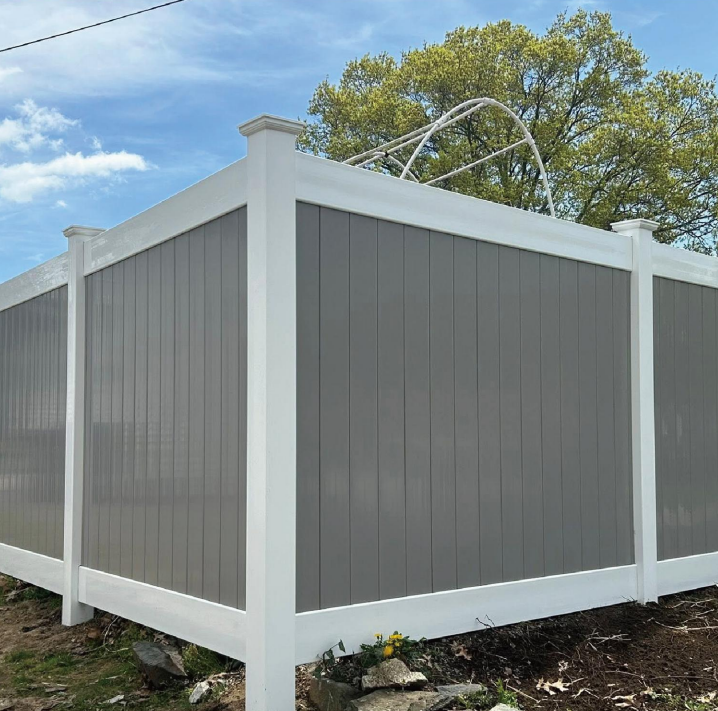
The company website names KMT004 as a full privacy fence with a two-tone colour, and the picture shows a corner of fencing with a coloured panel face set in a light frame and posts. The two-tone idea is simple: instead of a single colour across the whole fence, the panel face carries one colour and the frame and posts carry another, which breaks up a long run and draws attention to the structure of the fence. That contrast can suit a modern garden or a boundary where a plain panel would look too flat, and it is the main reason to consider this style over a single-colour privacy panel.
Colour choice for a two-tone fence is a two-part question, not a one-part question. The buyer must choose the panel face colour and the frame colour, and must confirm that the combination is offered for the KMT004 style, because the company pages used here do not publish a colour chart, and availability can differ between styles. The picture shows one combination, and it should not be read as a catalogue of all combinations. Naming the desired combination in the enquiry, and asking the supplier to confirm it, is the reliable route, and a sample in the intended combination is worth requesting for a large run.
Where a two-tone fence fits
A two-tone privacy fence fits the same screening jobs as any privacy fence: a garden boundary, a seating area edge, or a boundary facing a road or a neighbouring plot. The difference is purely visual, and it should be judged against the house, the planting, and any existing garden structures, because a contrasting frame that suits a modern house may clash with a traditional garden. The corner picture on the company website is a good test image, because a corner shows how the two colours meet and how the frame reads from an angle, which a straight-on panel picture does not.
Gates in a two-tone run deserve the same two-colour thinking. A gate that matches only one of the two colours will break the pattern at the entrance, so the enquiry should ask whether gates are offered in the same two-tone combination as the panels. The same applies to post caps and other finishing parts, which should be confirmed in the same enquiry. Listing the run, the gates, and the desired colour combination together gives the supplier everything needed to quote a coherent fence rather than a set of panels.
Two-tone fences and house colours
A two-tone fence should be judged against the house it stands beside, because the frame colour is the part that meets the house most directly. A light frame against a light house can disappear, while the same frame against a dark house can stand out sharply, and a coloured panel face can either echo a house colour or clash with it, depending on the shade. The reliable test is to view a sample of the intended combination against the house wall, in the light of the garden, before ordering a long run, because a combination that looks balanced in a catalogue picture may read very differently against a real house.
Planting also affects a two-tone fence, because shrubs and climbers will partly cover the lower panels over time, leaving the frame and the upper panels as the visible parts. A combination chosen for its panel face may therefore matter less after planting grows, while the frame colour matters more, since it remains visible above and between plants. A buyer planning dense planting should consider that long-term view, and should choose a frame colour that will still suit the garden when the planting matures, rather than a panel colour that will soon be hidden.
Questions to settle in your enquiry
- Which two colours are wanted, for face and for frame?
- Is that combination offered for the KMT004 style?
- Are gates and finishing parts available in the same combination?
Styles and ranges named on the company website: Two-Tone Fence Guide
- KMT004 — full privacy fence with two-tone colour