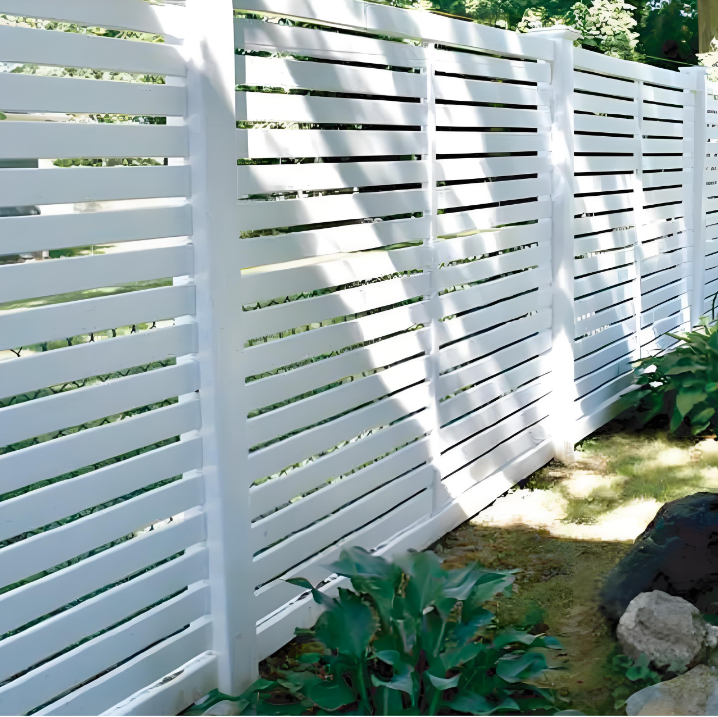
The company website semi-privacy range is presented as the middle ground between a closed privacy panel and an open picket design. The styles named on the company website for this range include KMT108, described as a semi-privacy vinyl fence, and KMT101, described as a louvered semi-privacy fence. The louvered picture shows horizontal slats with gaps, photographed in sunlight, and the semi-privacy picture shows a similar slatted arrangement. The visible difference is the slat treatment, and a buyer should compare the pictures at full size rather than relying on the style names alone.
Semi-privacy fencing suits boundaries where complete screening would feel too heavy or would block too much breeze. A side passage, a boundary beside a seating area that benefits from air movement, or a garden that needs partial screening from a neighbouring plot are typical cases. The gaps also change how the fence reads from inside the garden: instead of a solid wall, the boundary becomes a filtered edge, with planting visible through the slats and light falling in bands. That quality is hard to judge from a single photograph, which is why a sample or a larger picture set is worth requesting before a large order.
Louvered and plain semi-privacy styles
The louvered style uses angled or overlapping slats to break the direct sight line while keeping ventilation, and it is the style to compare first when the boundary faces a path or a neighbouring window at close range. The plainer semi-privacy style uses straight slats with even gaps, giving a more regular rhythm along the run and a simpler appearance against planting. Ask for dimensions and gap information for the particular semi-privacy style you are considering, and check the proposed arrangement against your viewing angle and screening needs rather than measuring a photograph or assuming that both styles have the same gaps.
Gates deserve the same attention as panels in this range. A semi-privacy double gate is shown on the company website, and a gate that matches the panel slats keeps the run coherent, while a solid gate in the same run would create a visual break. The enquiry should therefore ask whether gates are available in the same slat treatment as the chosen panels, and whether the gate hardware and accessories are supplied with the gate or sourced separately. Those are small questions, but they determine whether the finished run looks like one fence or like two fences joined together.
Comparing semi-privacy with full privacy
The decision between semi-privacy and full privacy usually turns on one question: from where will the fence most often be seen, and how complete must the screening be from that viewpoint? A fence seen from a neighbouring upper window needs a different answer from a fence seen from a ground-level path, because slats that screen at ground level may not screen from above. The comparison page for privacy against semi-privacy walks through that viewpoint question, and a buyer who is unsure should use it before settling on a style. In both cases, colour availability, gates, and ordering terms remain enquiry questions, and the enquiry pages on this site collect them in one place.
Semi-privacy fencing in small gardens
Small gardens benefit most from semi-privacy fencing, because a closed panel in a small space can make the garden feel smaller, darker, and more enclosed than it needs to feel. Semi-privacy slats keep a sense of openness while still softening the boundary, and the bands of light that fall through the gaps change through the day, which gives a small garden a livelier character than a flat panel wall. A buyer with a small garden should therefore compare the two ranges in the garden itself, if possible, rather than from photographs alone, because the feeling of space is difficult to judge from a picture.
Planting interacts with semi-privacy fencing in a way worth planning for. Climbers and shrubs will grow through and around slats over time, which can be an advantage, softening the fence and integrating it with the garden, or a disadvantage, if planting blocks the gaps that give the fence its light and air. The enquiry should consider the planting plan alongside the fence style, and should ask about cleaning access where planting will grow close to the fence, since a slatted fence behind dense shrubs is harder to clean than a closed panel in the open.
Questions to settle in your enquiry
- Do you need full screening, or is filtered light and air acceptable?
- Which slat treatment suits the site: louvered or plain?
- Are matching gates available in the same slat treatment?
Styles and ranges named on the company website: Semi-Privacy PVC Fence
- KMT108 — semi-privacy vinyl fence
- KMT101 — louvered semi-privacy fence