Privacy fence
Closed panels for screening a garden or seating area.
A full range of PVC fences and UPVC profiles, presented by fence type so that a buyer can compare styles before asking for a quotation.
Tianjin Kemitol Plastic Products Co., Ltd. describes itself on the company website as a manufacturer specializing in a full range of PVC fences and UPVC profiles. The fence ranges named on the site run from full privacy panels for a closed garden boundary, through semi-privacy panels that keep a degree of airflow and light, to open picket and ranch-rail designs that mark a boundary without closing the view. Quote the company website name of the range and the exact style in your enquiry, and ask the supplier to confirm that the quotation covers the panel you mean.
Start your fence search with the job the boundary must do. The category pages group the ranges by use: privacy fencing for screening, garden fencing for planting beds and paths, ranch-rail fencing for paddocks and larger plots, railing for decks and steps, and gates and accessories that complete an installation. The guide pages explain the differences between styles in plain language, and the enquiry pages collect the questions that cannot be answered from the company website alone, such as colour availability, custom sizes, and current ordering terms.
A fence that screens a seating area from a neighbouring plot is a different purchase from a fence that simply marks the edge of a field. Privacy panels close the sight line, semi-privacy panels soften it, and picket or ranch-rail designs leave it open. The right first step is therefore to decide how much of the view should remain, how much wind should pass through, and whether the fence must also keep animals in or out. Those three answers narrow the whole catalogue to one or two ranges, and they are the answers a supplier needs before any discussion of colour or quantity can be useful.
Garden and boundary work adds a second set of questions. A garden border fence sits low among planting and needs to survive soil contact, watering, and trimming equipment, while a boundary fence faces the weather on both sides and must stand through seasons of sun, rain, and frost. Railing, by contrast, is judged at hand height: it must feel steady, look clean from the house, and suit the deck or steps it edges. Keeping these jobs separate prevents a common mistake, which is to choose a style for its photograph and then discover that it answers the wrong question.
Where a style is shown, the caption says so, and where a picture is a company homepage illustration rather than a photograph of a finished installation, that distinction is kept. Request dimensions, performance information, and any compliance documents for the particular style and intended use, and check their scope before applying a figure from a single product to any other panel or to the range as a whole.
Request certificate documents for the order you are considering. Ask about certificates available upon request, naming the document, the destination market, and the intended application, and check the scope of any supplied document against the style you plan to order. Ask the supplier to confirm minimum quantities and lead times for the selected style, colour, quantity, and destination before making a purchasing commitment or scheduling work around an assumed delivery date. State the style, colour, and quantity in your enquiry, and list the remaining points you need the supplier to confirm.
The company website navigation lists ten categories: PVC Fences as the index, Privacy Fence, Semi-Privacy PVC Fence, Garden Fence, Other Fence, Ranch-Rail Fence, Railing, Gate, Accessories, and U-PVC profiles. Use those company category names when comparing ranges and writing an enquiry, and quote the exact style name within the relevant category so the supplier can identify the product you mean without translating between different descriptions. The index category gathers the whole fence side of the range, while the remaining categories each answer one job, from screening a garden to edging a deck.
The product descriptions on the company website add further phrases that do not appear as navigation categories: picket fence, horse fence, pool fence, and garden border fence, together with custom window-door profiles and decorative profiles on the profile side. For picket, horse, pool, or garden border fencing, identify the nearest named range and describe the intended use in your enquiry; ask the supplier which style fits rather than assuming that an application name identifies a separate product line. Keeping the navigation categories and the descriptive phrases separate prevents a buyer from mistaking a description for a product line.
Although the company name is most often associated with fencing, the range has two families that are ordered in different ways. The fence family is bought by boundary and by run: a buyer measures lengths, counts gates and corners, and chooses a screening level. The profile family is bought by application: window and door profiles for frames, and decorative profiles for trim and features, with the company website naming five series, 60, 65, 80, 88, and 92, for its profile range. For either family, use the same enquiry route but describe the relevant job: boundary and screening needs for fencing, or the frame, feature, and setting for profiles.
The company website also states that the business is located near Tianjin ports and supports mixed container loading for fences and wire mesh products. If you plan to combine fence panels with other goods in one shipment, ask the supplier which combinations are possible for that order and confirm the loading arrangement before treating mixed loading as an agreed shipping term. A buyer with a mixed shipment should raise it in the enquiry, naming the goods to be combined, so that the supplier can confirm what is possible for that particular order.
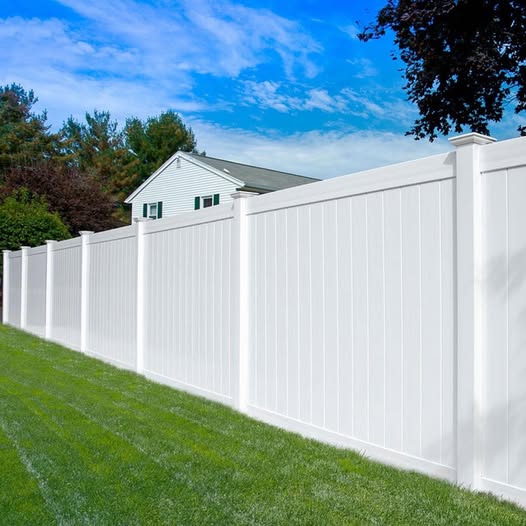
The picture at the top of this page shows the KMT001 full privacy fence in a garden setting, as shown on the company website, and it is the clearest single illustration of what a closed privacy panel looks like once installed: a uniform white face, a level top line, and a garden behind it. Use the company website style name in each picture caption when asking about a fence, and request another view if the photograph does not show the detail you need. Where a picture is a company homepage illustration rather than a photograph of a finished installation, the caption keeps that distinction, and where a picture shows a workshop, it is captioned as a production workshop image shown on the company homepage, not as a verified photograph of a particular factory floor.
Pictures are useful for comparing outlines, but they cannot settle the questions that decide an order. A photograph does not state the colour range, the gate options, the certificate documents, or the ordering terms, and the same style can look different in different light and against different planting. The right way to use the pictures is therefore to narrow the choice to one or two styles, and then to put the remaining questions to the supplier in the enquiry, naming the style exactly as it appears in the caption. That habit also protects the buyer: a style name quoted from a caption leaves no room for confusion between panels that look alike in a small photograph.
Work through the fence decisions before choosing a product and requesting a quotation. The privacy against semi-privacy comparison turns on viewpoint, light, and airflow; the picket styles guide turns on the three top outlines, straight, scalloped, and closed; the vinyl against wood comparison turns on maintenance and appearance questions; and the installation, colour, customisation, certificate, sample, and ordering guides each gather one group of enquiry questions. A buyer who works through the guides in that order will arrive at the enquiry with a style, a colour question, a gate count, and a market in mind, which is everything a quotation needs except the figures that only the supplier can confirm.
Use the product pages to identify a named style, then list the points you need the supplier to confirm in your enquiry. Separate the style names and pictures you have already checked from the questions still open for the order, and ask the supplier to confirm those open points for the exact style you intend to buy. Before ordering, ask the supplier to confirm the minimum quantity and lead time for your selected style, colour, quantity, and destination, and request any certificate document by name with its market and application so you can check what has been agreed and what still needs an answer.
Start by naming the fence job, whether screening, edging, or marking a paddock, and compare the ranges that answer that job before choosing a material or a catalogue style. A buyer rarely arrives thinking about extrusion or about a catalogue code; a buyer arrives thinking about a boundary that needs screening, a garden that needs edging, or a paddock that needs marking. Grouping by job lets that buyer ignore the ranges that do not apply and compare only the ranges that do, which shortens the decision and reduces the chance of ordering a style for the wrong purpose. It also makes the enquiry easier, because the buyer can name the job and the range together, and the supplier can reply in the same terms.
Job grouping also helps where a buyer needs more than one range, which is common. A property may need privacy fencing on one boundary, picket fencing at the front, and railing on a deck, and a job-grouped site lets the buyer collect those three decisions separately, with a separate enquiry checklist for each, rather than trying to hold a single catalogue decision in mind. For each job, work through its category checklist and list the remaining questions with the style name, run length, gate count, and market, then ask the supplier to confirm the details needed for that part of the order.
Closed panels for screening a garden or seating area.
Panels with gaps that keep light and air moving.
Open picket styles in straight, scalloped, and closed tops.
Garden and garden border fencing from the company range.
Open rail fencing for paddocks and larger plots.
Window and door profiles and decorative profiles.