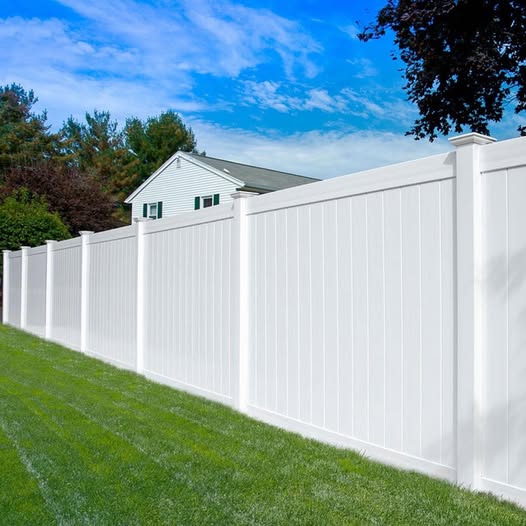
The company website privacy range is built around closed panels. The styles named on the company website for this range include KMT001, described as a full privacy fence, KMT008, described as a privacy fence with a picket top, and KMT002, described as a full privacy fence with panels. The pictures on this page are company website pictures for those styles, captioned by style name, and they show the panels in garden settings with lawns and houses behind them. A buyer comparing these pictures should look at the top edge and the panel joints, because those are the visible differences between the styles.
A privacy fence is chosen for screening first and for appearance second. The closed panel blocks the view from outside, which suits a seating area, a terrace edge, or a boundary that faces a road or a neighbouring plot. The same closed surface also catches more wind than an open design, so the ground, the posts, and the fixing method deserve attention in the enquiry, even though this site does not publish fixing or wind figures. A buyer should ask the supplier what fixing and post arrangements are recommended for the ground conditions on the site, and whether gates in the same style are available for the same run.
Choosing between the privacy styles
The three named styles differ mainly in their top treatment and panel arrangement. A plain full privacy panel gives an even top line and a uniform face, which suits a formal garden edge or a boundary where a clean line matters. A privacy panel with a picket top keeps the closed lower section and adds a decorative top, which softens the outline against planting and suits a garden where the fence is seen against shrubs. The panel style with a different panel arrangement gives a buyer a further visual choice within the same closed-panel idea, and the right choice is usually the one that matches the house and the planting rather than the one that looks most solid in isolation.
Colour is the second choice, and it should be settled as an enquiry question. The two-tone style shown elsewhere on this site pairs a coloured panel face with a light frame and posts, which shows that colour is not limited to a single all-over finish, but the full set of available colours is not published on the company pages used here, and this page does not list a colour chart. A buyer with a colour in mind should name it in the enquiry and ask the supplier to confirm availability for the chosen style, since colour availability can differ between styles.
Where privacy fencing fits, and where it does not
Privacy panels fit boundaries where screening is the main requirement: the edge of a private garden, the side of a terrace, or the boundary of a property that faces a public path. They are less suitable where airflow matters more than screening, for example along a narrow passage that needs ventilation, or where an open view is part of the garden design. In those cases the semi-privacy range, which keeps gaps between slats, is usually the better comparison, and the comparison page for privacy against semi-privacy sets out the trade-off in detail.
A privacy run also needs its finishing parts considered at the same time. Gates in the same style keep the screened line unbroken, and accessories such as post caps complete the appearance. A quotation that covers panels alone will leave the buyer to source matching gates separately, which risks a visible mismatch. The enquiry should therefore list the total run, the number of gates, and any corners or changes of level, so that the supplier can quote the complete job rather than panels in isolation.
Privacy fencing beside neighbours and roads
A privacy fence beside a neighbouring property raises a social question as well as a practical one, because a tall closed fence changes light, outlook, and the feeling of space for both sides. Where a boundary is shared, discussing the height, colour, and style with the neighbour before ordering can prevent a dispute that no fence design can fix, and it can also reveal a shared preference, such as a picket top that softens a closed panel, that suits both gardens. The enquiry should still be written in the buyer name, with the agreed style, so that the supplier quotes a decision rather than reopening a discussion.
A privacy fence beside a road faces a different set of conditions: traffic dust, spray, and public contact, all of which affect cleaning and appearance over time. A fence beside a road should be easy to clean, and its colour should be judged against the road surface and the house, not only against garden planting. Gates on a road boundary also need attention, because they open onto a public space and must close securely, and the gate style should match the panels so that the entrance does not break the screened line at the point where it matters most.
Questions to settle in your enquiry
- Which privacy style suits the site: plain, picket top, or panel style?
- What colour do you need, and is it available for that style?
- How many gates and corners does the run include?
Styles and ranges named on the company website: Privacy Fence
- KMT001 — full privacy fence
- KMT008 — privacy fence with picket top
- KMT002 — full privacy fence with panels