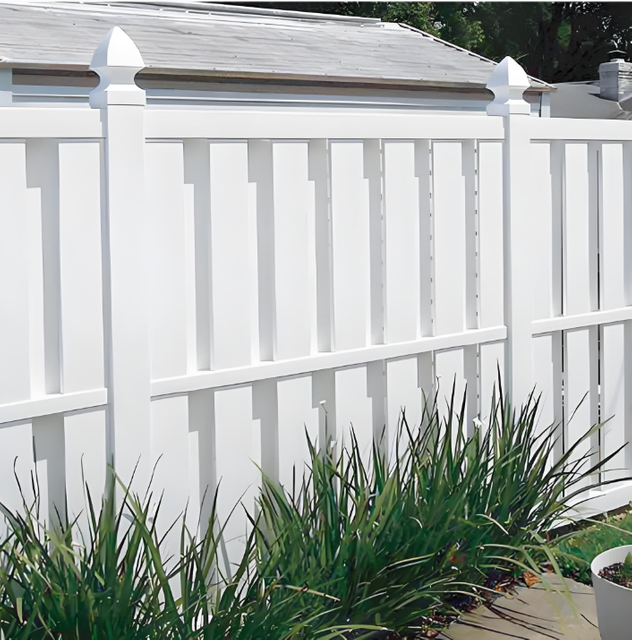
Full privacy panels close the sight line, while semi-privacy panels keep gaps that let light and air through. In a photograph both can look like white panels in a garden, which is why the comparison is worth making carefully. The practical difference appears when the fence is seen from different viewpoints: a semi-privacy panel that screens well from a ground-level path may screen less well from an upper window, because the gaps that read as closed at one angle open at another. A buyer should therefore think about the viewpoint that matters most, whether that is a neighbouring ground floor, an upper window, a path, or the garden itself.
Light and airflow are the second part of the trade-off. A closed panel gives the most complete screening and the most shelter from wind, but it also gives the most shade and the least ventilation, which can matter in a small garden or a narrow side passage. A semi-privacy panel gives up some screening in exchange for light and air, which can make a small space feel larger and a seating area more comfortable on a warm day. Neither outcome is better in general; the better range is the one that matches the space and the viewpoint.
A simple way to decide
Stand where the fence will most often be seen from, and ask how complete the screening must be from that spot. If the answer is complete, for a seating area that faces a neighbouring window at close range, the privacy range is the natural starting point. If the answer is partial, for a boundary that needs softening rather than closing, or a passage that needs air, the semi-privacy range is the natural starting point. If the answer differs between viewpoints, for example complete from the path but partial from the garden, the decision should follow the viewpoint that causes the most concern, and the other viewpoint should be checked against that choice.
Gates and colour should be decided with the same style, not after it. A privacy gate in a semi-privacy run, or the reverse, breaks the line at the entrance, and a colour that is available for one range may not be available for the other. The enquiry should therefore name the chosen range, the gate requirement, and the colour together, and ask the supplier to confirm all three for the same order. That single enquiry avoids the common pattern of a panel order followed by a separate, mismatched gate order.
Screening from upper windows and from paths
The hardest screening problem is a boundary that must screen from two different heights at once, for example a neighbouring upper window and a ground-level path. A semi-privacy panel that screens the path may not screen the window, because the viewing angle changes what the gaps reveal, while a full privacy panel screens both but gives up light and air. A buyer facing that problem should decide which viewpoint matters more, and should also consider whether planting, a taller panel section, or a combination of styles along different parts of the run could answer both viewpoints. Those combined solutions are worth discussing with the supplier, because a single style along the whole run is not always the best answer.
Neighbour relations are a further, practical part of this decision. A fence that screens completely may be welcomed by one neighbour and resented by another, especially where it shades a garden or blocks a view, while a semi-privacy fence is often easier to agree on because it softens rather than closes the boundary. Where a boundary is shared, discussing the choice with the neighbour before ordering can prevent a dispute that no fence style can fix, and the enquiry should still be written in the buyer name, with the agreed style and colour, so that the supplier quotes the decision rather than reopening it.
Questions to settle in your enquiry
- From which viewpoint must screening be complete?
- How much light and airflow does the space need?
- Which gate style and colour match the chosen range?