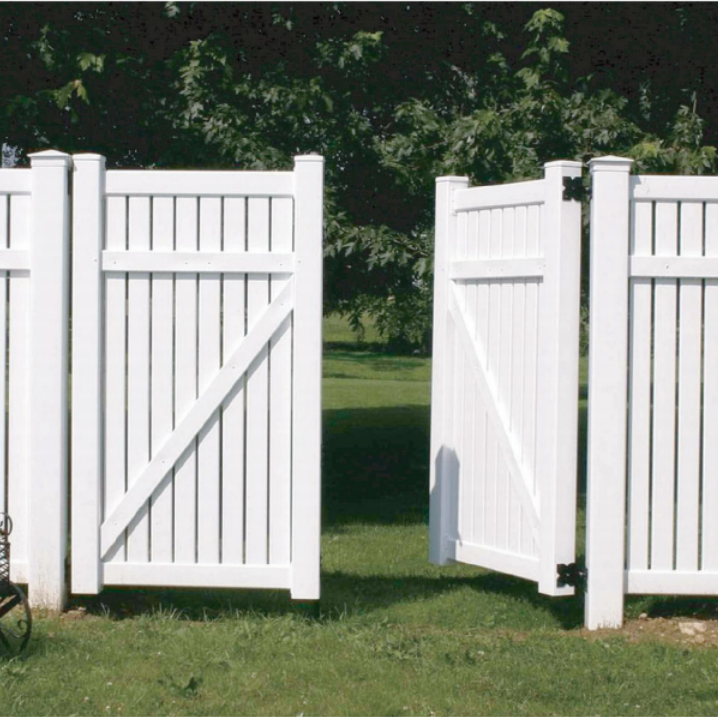
The company website navigation lists gate as one of its ten ranges, and the company website shows a semi-privacy double gate with accessories. That picture is useful because it shows the gate as a complete unit: two leaves, a slatted face that matches semi-privacy panels, and a garden setting that gives a sense of scale. A gate is the most used part of any fence, opened and closed daily, and it is also the part most often mismatched, when panels are ordered first and a gate is added later from a different style.
The first gate question is therefore about matching. A privacy run needs a privacy gate, a semi-privacy run needs a semi-privacy gate, and a picket run needs a picket gate, because a mismatched gate breaks the line of the fence at exactly the point where visitors enter. The second question is about size and opening: a pedestrian gate, a double gate for vehicles or equipment, and a garden gate each answer a different need, and the width should be measured from the actual access requirement, including any mower, barrow, or vehicle that must pass through.
Double gates and accessories
A double gate suits an entrance that must open wide, for example a drive, a paddock entrance, or a garden entrance used by machinery. The company website semi-privacy double gate is the named example on this site, and a buyer who needs a wide entrance should ask whether a double gate is offered in the same style as the chosen panels, and what accessories are supplied with it. Accessories in this context means the fittings that make the gate work and look finished, and the enquiry should ask which fittings are included, rather than assuming a complete set.
Single gates raise a simpler set of questions, but they should still be asked explicitly. The opening direction, the fixing to the adjacent posts, and the way the gate meets the fence line all affect whether the gate hangs well and closes cleanly. This site does not publish fixing or hardware figures, so those questions belong in the enquiry, together with the gate width and the style name. A gate ordered with those answers given is far more likely to arrive as a matching part of the fence than a gate ordered by style name alone.
Gate widths, swing, and daily use
A gate width should be measured from what must pass through it, not from the gap left in the fence, because those two measurements often differ. A pedestrian gate needs only a comfortable walking width, while a gate used by a mower, a barrow, or a vehicle needs the width of the widest item plus room to manoeuvre, and a gate that is ordered too narrow will either be replaced or will force awkward handling every time it is used. The enquiry should list everything that must pass through the gate, including any equipment that is only used seasonally, because a seasonal item forgotten at ordering time becomes a permanent inconvenience.
Swing and closing are the daily-use questions that follow width. A gate should open in the direction that suits the approach, clear any slope or surface change in its swing, and close securely without lifting or dragging. Those points depend on the site, not on the gate style alone, so the enquiry should describe the ground on both sides of the gate and any slope in its swing path. A supplier who knows the site can advise on the gate arrangement, while a supplier given only a width will quote a gate that may not suit the ground it stands on.
Questions to settle in your enquiry
- Which fence style must the gate match?
- Is a single or double gate needed, and what width must it open to?
- Which accessories and fittings are supplied with the gate?
Styles and ranges named on the company website: Gate
- Semi-privacy double gate